Introduction: Building With AI
Artificial intelligence is rapidly becoming a core business capability, changing how organizations build products, improve customer experiences, optimize operations, and create new opportunities for growth. What was once treated as an emerging technology is now becoming part of the foundation on which modern digital products are designed, engineered, and scaled.
AI-first product engineering goes beyond adding a chatbot, recommendation engine, or automation feature to an existing application. It means designing products with intelligence as a fundamental part of the architecture, user experience, data strategy, and operational model from the beginning. This shift allows businesses to build systems that can adapt to changing customer needs, automate complex workflows, and continuously improve through data.
The organizations gaining the most value from AI are not simply experimenting with models. They are connecting AI capabilities to measurable business objectives and building reliable engineering foundations around them. The result is a more intelligent product development approach where technology, strategy, and execution work together rather than operating as separate initiatives.
At ArgonTeq, we help startups and enterprises build AI-driven digital products by combining product engineering, business strategy, data, and modern technology to create solutions designed for measurable and sustainable business value.
The AI Shift
Traditional software development typically begins with application functionality and introduces intelligence later as the product evolves. AI-first product engineering reverses that mindset. Instead of asking where AI can be added to an existing system, organizations begin by identifying where intelligence can fundamentally improve the product, customer experience, or business operation.
This shift requires engineering teams to think beyond individual features and consider the role of AI across the entire product lifecycle. Intelligent systems can analyze large volumes of data, understand patterns, personalize interactions, automate repetitive workflows, and support decisions that previously depended entirely on manual processes.
The strategic questions therefore become more important than the technology itself. Organizations need to determine where AI can create meaningful value, which workflows can benefit from intelligent automation, how available data can improve user experiences, and which business decisions can become faster and more accurate through AI.
When these questions are answered before implementation begins, AI becomes part of the product strategy rather than an isolated technology experiment. This creates a foundation for products that can become more useful, efficient, and responsive as they accumulate data and real-world usage.
For businesses, this creates an opportunity to move from static applications toward intelligent systems that continuously learn from customer behavior, operational data, and changing market conditions.
Beyond AI Features
Many organizations begin their AI journey by introducing a single capability such as a chatbot, recommendation engine, document-processing workflow, or automated assistant. While these features can provide immediate value, long-term AI transformation requires a broader approach that connects intelligence to the complete product and business ecosystem.
Successful AI products are designed around outcomes rather than technology. The objective is not simply to demonstrate that a model works, but to determine how intelligence can improve the way customers interact with a product and how teams operate the business behind it.
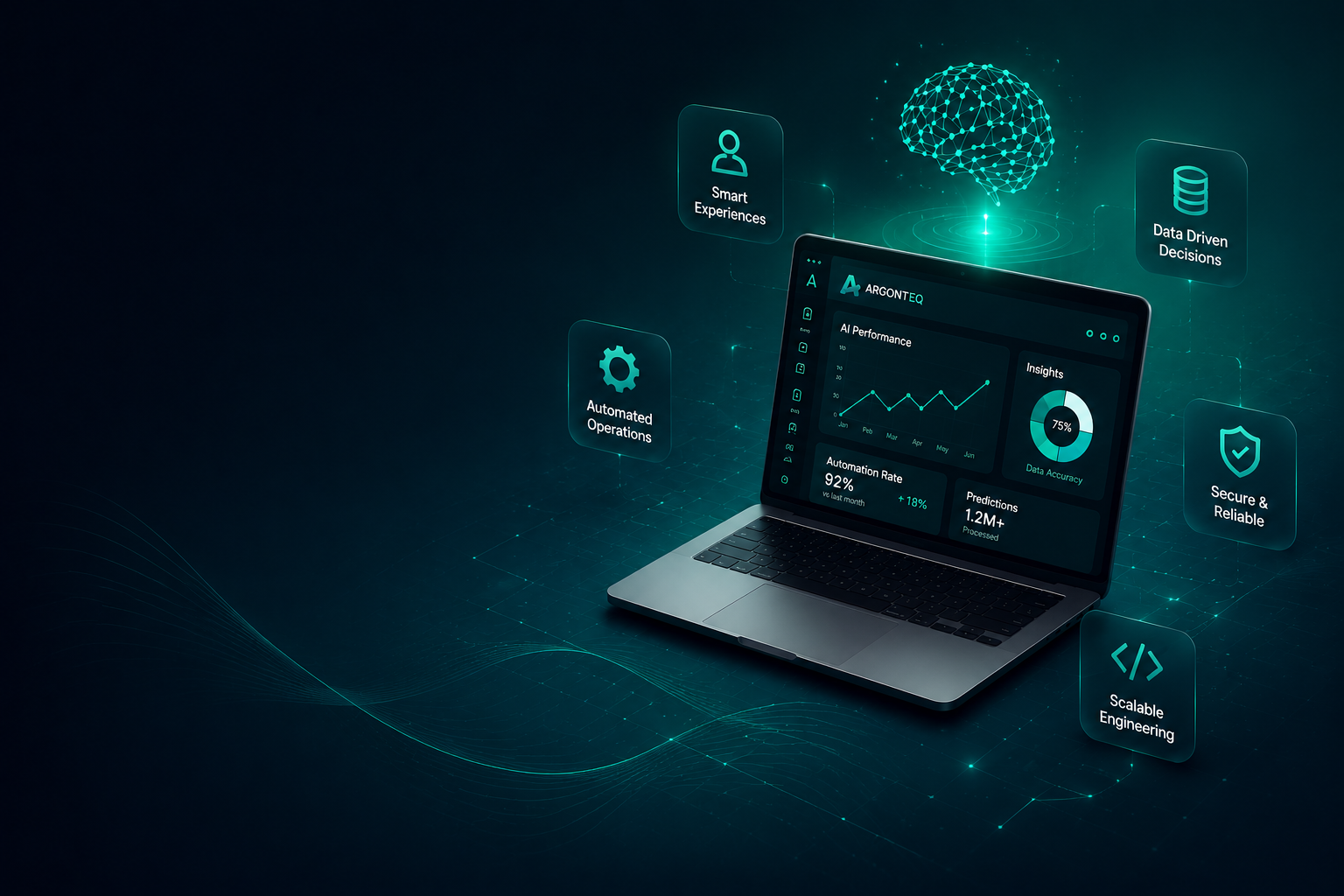
Smart Experiences
AI can transform customer experiences by understanding behavior, preferences, context, and intent. Personalized recommendations, intelligent search, conversational interfaces, and adaptive workflows allow products to respond to users in ways that feel more relevant and useful. Instead of presenting the same experience to every customer, intelligent products can adapt based on real-world interactions.
Automated Operations
AI-powered automation can reduce repetitive manual work across customer support, administration, content processing, sales operations, and internal workflows. By combining intelligent decision-making with traditional automation, businesses can streamline complex processes while allowing employees to focus on higher-value activities that require creativity, judgment, and human interaction.
Data Driven Decisions
Modern organizations generate enormous amounts of operational and customer data, but data alone does not create business value. AI can transform that information into actionable insights by identifying patterns, detecting anomalies, forecasting outcomes, and supporting faster decision-making. This enables leadership and operational teams to make decisions based on evidence rather than assumptions.
Continuous Improvement
The most valuable AI products are designed to improve over time. Usage data, customer feedback, performance metrics, and operational outcomes can provide the information required to refine models, optimize workflows, and improve product experiences. Continuous learning therefore becomes part of the product lifecycle rather than a one-time development activity.
AI-first product engineering is not about adding intelligence to existing software. It is about building products where AI, data, and automation work together from the foundation to create measurable business value.
The goal is ultimately bigger than adding AI capabilities. It is about creating products where intelligence delivers measurable improvements in customer satisfaction, operational efficiency, product performance, and business growth.
Validate Before Building
One of the biggest challenges in AI product development is starting with technology instead of the problem. Organizations can easily become focused on selecting models, experimenting with APIs, or building prototypes without first establishing whether the proposed solution addresses a meaningful business need.
Effective AI engineering begins with validation. Before development starts, teams should understand the problem being solved, identify the expected business outcome, evaluate the available data, determine how success will be measured, and identify the risks associated with implementation.
This validation process also helps determine whether AI is actually the right solution. Some problems may be better addressed through traditional software, workflow automation, improved data architecture, or changes to an existing business process. AI should be introduced where it creates meaningful value rather than simply because the technology is available.
A strong AI roadmap connects customer needs, business objectives, product requirements, engineering decisions, and measurable outcomes. This alignment reduces wasted development effort and gives teams a clearer path from experimentation to production.
Organizations that validate AI opportunities before building are better positioned to avoid expensive proof-of-concepts that never become reliable products. They can focus engineering resources on initiatives that have a realistic path toward adoption, scalability, and commercial impact.
AI Engineering Governance
Building an AI-powered product requires significantly more than selecting a model or integrating an AI API. Production systems need reliable infrastructure, secure data management, scalable architectures, monitoring, testing, and processes for continuously evaluating AI performance.
As AI becomes embedded in customer-facing and mission-critical applications, engineering governance becomes increasingly important. Teams need to understand how systems behave under real-world conditions, how data flows through the platform, and what happens when models produce unexpected results.
Scalable Architecture
AI workloads can introduce new requirements around compute, storage, inference, integrations, and data processing. Scalable architecture allows organizations to support growing usage while maintaining predictable performance. The architecture should also remain flexible enough to accommodate new models, services, and AI capabilities as technology evolves.
Data Management
AI performance is closely connected to the quality, security, and accessibility of the underlying data. Organizations need reliable data pipelines, appropriate access controls, data governance, and processes for maintaining data quality. Treating data as a first-class engineering capability creates a stronger foundation for accurate and dependable AI systems.
Product Reliability
AI-powered products still need to meet the same expectations for reliability, security, and usability as traditional software. Customers need consistent experiences, predictable system behavior, and appropriate safeguards when AI is involved in important workflows. Reliability therefore needs to be designed into the product rather than addressed after launch.
Continuous Optimization
AI systems require ongoing evaluation because performance can change as user behavior, data, business requirements, and models evolve. Monitoring, feedback loops, testing, and performance analysis allow engineering teams to identify weaknesses and continuously improve the system. This creates an operational cycle where production data informs future product and engineering decisions.
Without strong engineering governance, organizations risk creating AI solutions that appear innovative during experimentation but struggle to deliver consistent commercial value once deployed at scale.
Strategy Meets Execution
AI initiatives are most successful when business strategy, engineering execution, and market requirements remain closely connected throughout the product lifecycle. A technically impressive AI system can still fail if it does not solve an important customer problem or provide a clear business advantage.
Business Strategy
AI product development should begin with an understanding of customer needs, market opportunities, operational challenges, and revenue objectives. Strategy determines where AI can create the greatest impact and ensures that engineering investments support broader business priorities rather than isolated technical experiments.
Engineering Excellence
Once the opportunity has been validated, engineering teams must translate the strategy into secure, scalable, and maintainable technology. This includes architecture, APIs, data infrastructure, AI integrations, testing, observability, deployment, and ongoing optimization. Strong engineering practices turn AI concepts into dependable products that can operate in real-world environments.
Go To Market
Even a well-engineered AI product needs a clear path to customer adoption. Users need to understand the value of the product, trust its behavior, and see how it improves their existing workflows. Product positioning, onboarding, usability, pricing, and customer feedback therefore become as important as the underlying technology.
From AI applications and SaaS platforms to CRM, ERP, mobile applications, and blockchain solutions, successful digital products are built by connecting technology decisions with business outcomes. Strategy defines the opportunity, engineering creates the solution, and go-to-market execution turns that solution into sustainable adoption.
Choosing an AI Partner
Building AI-powered products often requires expertise across product strategy, software engineering, data, infrastructure, and artificial intelligence. Organizations therefore need a technology partner capable of understanding both the technical complexity of AI and the business outcomes the product is expected to deliver.
The right engineering partner should help identify practical AI opportunities rather than simply recommend technology. They should be able to evaluate existing systems, design scalable architectures, build intelligent workflows, manage engineering risks, and create a roadmap that can evolve as the business grows.
A strong partner can also accelerate the transition from concept to production by helping teams validate ideas, develop prototypes, establish engineering foundations, and continuously optimize the resulting product. This approach reduces the gap between AI strategy and actual execution.
At ArgonTeq, our AI-first product engineering approach combines business understanding with modern engineering practices to help startups and enterprises build intelligent digital solutions. From early-stage product validation to scalable production platforms, the focus remains on creating technology that solves real problems and generates measurable business value.
Conclusion: Build Smarter
The future of software development is not simply about building faster. It is about building products that are more intelligent, adaptable, efficient, and aligned with the needs of the businesses and customers they serve.
AI-first product engineering gives organizations a framework for achieving that goal by bringing together artificial intelligence, product strategy, data, engineering, and continuous optimization. When these disciplines work together, AI can become more than an experimental capability and instead become a foundation for sustainable digital transformation.
Before beginning your next technology initiative, consider whether your organization is using AI strategically, whether the proposed solution addresses the right business problem, and whether your engineering architecture is prepared to support future growth.
The companies that successfully combine AI innovation with strong product strategy and engineering discipline will be better positioned to create the next generation of intelligent digital experiences.
Read the full article and connect with ArgonTeq to explore how an AI-first product engineering approach can help transform your next product idea into a scalable digital solution.